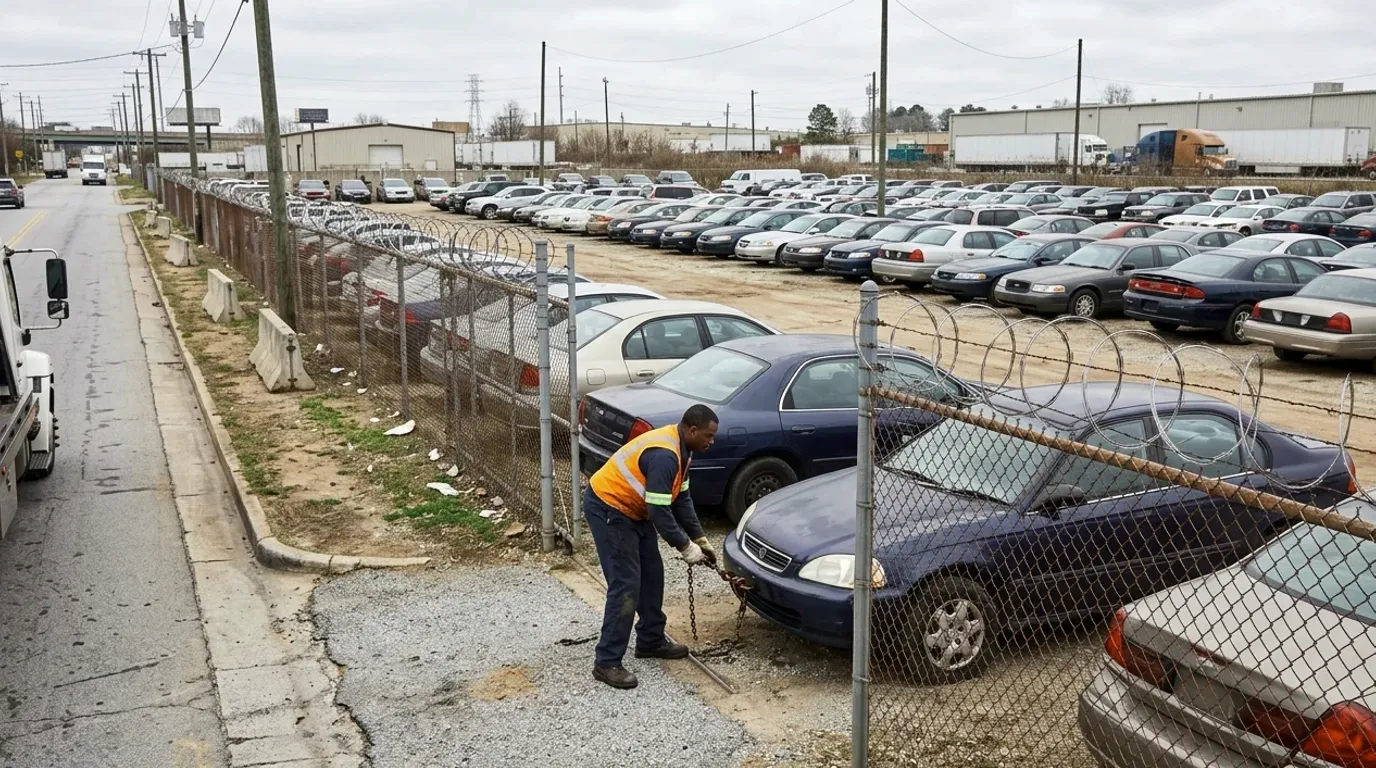
If you do not collect a towed car in Georgia, the storage bill keeps climbing, the yard has to contact you and any lender on the title, and eventually the yard can pursue a lien that ends with the car being sold. The exact day counts for that last stage are not something I could confirm from a primary source, so this post gives the process in order and says where the numbers stop.
The short advice is to move early. Every day costs money, and the options narrow the longer the car sits.
The first 24 hours are the cheapest
Under Georgia’s rule for non-consensual towing, a private-lot operator cannot charge storage for the first 24 hours after the car leaves the property. Storage also cannot be charged for any day the lot is closed or the car is otherwise unavailable for you to redeem. The state rule says that in plain terms.
Police and agency lots set their own schedules:
- City of Atlanta. Tow fee capped at $125, with no storage for the first 24 hours (Atlanta Code § 162-227).
- DeKalb County lot in Tucker. $125 to impound, then $15 per day.
- Hartsfield-Jackson. $2.50 per day after the first day.
- Fulton County. Cars are released through the Marshal’s office at 185 Central Ave SW, 9th Floor, Monday to Friday, 8:30 a.m. to 5 p.m.
How the bill grows at a private-lot yard
For a car of 10,000 pounds or under, the state’s Tariff No. 5 allows storage of up to $33 per day after the free 24 hours. It also allows additional fees of up to $65 after 72 hours and caps notification charges at $91.
A quick bit of arithmetic shows why waiting hurts. At the $33 ceiling, ten billable days of storage comes to $330, before the tow itself. That is the most the tariff allows, not a bill any particular yard has charged, and your actual bill depends on the operator.
Storage also stops the moment you claim the car and pay. The rule says no further storage charge may be added once the vehicle is claimed and payment tendered in the amount on the receipt.
What the yard has to do
The Georgia Department of Revenue (DOR) says towing and storage firms must notify vehicle owners, lienholders and security interest holders when a car has been towed and impounded. That notice is part of the Abandoned Motor Vehicle Act, which begins at O.C.G.A. § 40-11-11 on the DOR page. The DOR also says a firm that wants to foreclose on a lien must notify owners, lienholders and security interest holders.
To find you, a yard can request owner and lienholder contact information from the state. The DOR’s abandoned vehicles page describes the form for that, MV-603, and says the firms may use an online data service or a local law enforcement agency. So a letter may go to the address on your registration. If you moved and did not update it, you may never see the letter, which is one more reason to call the yard yourself.
Where the process goes if the car stays
Based on the DOR’s description, the path looks like this:
- The car is towed and stored, and the yard gets owner and lienholder details.
- Notices go out to the owner, lienholders and security interest holders.
- If nobody claims the car, an authorized business may foreclose on its lien by following the detailed notification process.
- The car can be sold at a public sale, and the DOR says proceeds of the sale have to be sent to the Department of Revenue.
I did not confirm how many days each step takes, what notice wording is required, or what a lien sale pays the yard first. The statute, O.C.G.A. § 40-11-1 and the sections after it, is where those answers are, and I could not open it. The DOR also says a title cannot be issued on a bond alone for an abandoned vehicle, which protects owners from shortcut sales.
Separately, the Georgia law treats a vehicle as abandoned after 30 days in specific situations: unclaimed at a repair shop 30 days past the agreed time, towed to another’s property at the owner’s request and left 30 days without paying the charges, or left unattended on private property for 30 days.
Options if you cannot afford the full bill
- Call the yard today. Ask for the exact total, what each line is, and how it grows by the day.
- Ask the yard about limits. The tariff gives ceilings for private-lot tows. Compare your bill against them.
- Retrieve belongings. I could not confirm a statewide rule on belongings, so ask the yard what it allows and get it in writing.
- Talk to your lender. If a loan is on the car, the lender may want the car back before it is sold. The yard is supposed to notify them.
- Decide whether the car is worth it. If the bill exceeds what the car is worth, the lien may be more than you want to pay, but do that math with the real figures, and think about the effect on any loan before you walk away.
Getting it moved after you pay
Once you have the car out, you may need a hauler if it will not run. Ask for flatbed towing if it cannot roll. If it is headed to scrap instead, junk car removal and our guide to junking a car in Georgia cover the steps.
Frequently asked questions
How long can a tow yard keep my car in Georgia?
I could not confirm a single deadline. The yard follows the notice and lien process under the Abandoned Motor Vehicle Act, and the DOR says an unclaimed car can be sold at public sale.
Will I get a letter before the car is sold?
The DOR says firms must notify owners, lienholders and security interest holders. Letters go to the address on record, so check yours.
Do I owe money after a sale?
I did not confirm that. Ask the yard in writing what it claims you owe after any sale.
Does storage stop after I pay?
Yes. Under the state rule, no storage fee can be added once you claim the car and pay the amount on the receipt.
For a tow or roadside call in metro Atlanta, the line is (858) 925-5546.