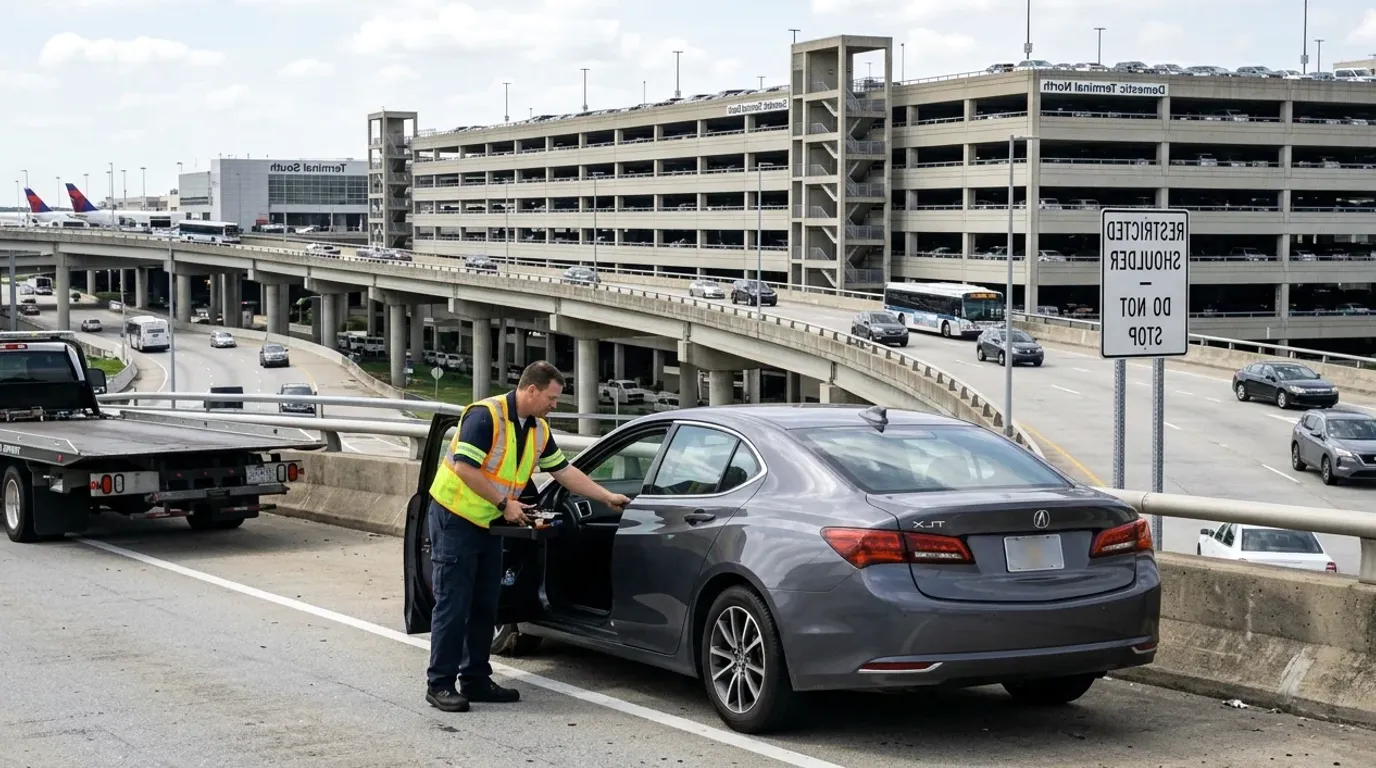
A private-property tow in Georgia can be illegal if the lot had no proper sign, if the operator was not called for your specific car, if the towing company had no written contract with the owner, or if the bill is above the state’s ceiling. Any one of those is a reason to dispute the charge. Work through the checks below before you pay, and photograph everything while you still can.
These rules apply to non-consensual tows from private property under O.C.G.A. § 44-1-13 and the Georgia Department of Public Safety rate tariff. A tow ordered by police, or one you asked for yourself, plays by different rules.
First, confirm this is the right set of rules
The Georgia Attorney General’s towing and booting page says the state law does not cover consensual towing, towing from government property, or towing within a municipality that has not authorized towing by ordinance. A city that does allow it may layer on stricter rules, including a lower fee cap than the state tariff.
So ask yourself who ordered the tow. A property manager or owner is the situation this page covers. A police officer is the city or county impound process, which follows different rules.
Check one: the sign
The statute requires a conspicuously posted notice saying vehicles may be removed at the owner’s expense, along with where the vehicle can be recovered, the recovery cost and the form of payment. Our research file for this site also records the physical requirements: posted within 50 feet of each entrance (or visible from every space where there is no entrance), at least 12 inches by 18 inches, with lettering at least three-quarters of an inch tall.
One exception matters. Per the statute text published by FindLaw, owners of residential property with no more than four units are exempt from the posting requirement. A duplex landlord is not held to the same signage standard as a 300-unit complex.
Photograph the sign, the entrance, and the spot where you parked, in that order, with a timestamp.
Check two: was the operator called for your car
The research file records that automatic or systematic surveillance of a lot for the purpose of towing is unlawful, with a $1,000 fine, and that tow companies may not pay property owners for the right to tow. In practice, a lawful tow starts with the owner or an agent asking the operator to remove a particular vehicle, the same day. Ask the operator when the request came in and who made it. A company that cannot answer is telling you something.
Check three: the contract and the permit
The Attorney General’s guidance says a company towing from private property must have an agreement with the property owner and must have filed with DPS. Ask to see the permit. Under the rate tariff, permit holders must post the permit at the main office and carry a copy in the truck.
Check four: the bill
For a vehicle of 10,000 pounds gross weight or less, the DPS Maximum Rate Tariff No. 5, effective June 17, 2024, sets these ceilings: $228 for the tow, $33 per day for storage with none charged for the first 24 hours, up to $65 in additional fees after 72 hours, and no more than $91 in total notification charges. These are maximums. A bill above them is a red flag, and a bill at them is not automatically fair, since an operator may charge less.
One more rule from the tariff: if the car has not been hooked or loaded yet and you come back with the key and drive it off right away, the operator cannot charge you.
If the tow was inside the City of Atlanta by police order, the city cap in Atlanta Code § 162-227 is $125 with no storage for the first 24 hours. Do not mix the two numbers up when you dispute a charge.
Check five: the paperwork
Ask for an itemized receipt showing the tow fee, storage and any notification charge. Keep the receipt, the name of the person who took payment, and the company name. The Attorney General’s page makes the same point for boots: these details matter if you dispute later.
How to dispute it
Paying to get the car out does not end your options. A sensible order:
- Contact the company in writing. State the problem, attach the photos, and ask for a refund of the amount over the ceiling or for the whole fee if the sign was missing.
- Tell the property owner. The Attorney General’s guidance notes owners contract with these companies and should know if drivers are being towed improperly.
- File with DPS. The department regulates non-consensual towing and has a complaint form for towing companies, Form TR0031, on gamccd.net.
- Consider a lawsuit. The statute lets a person injured by a violation bring an action. Actual damages are presumed to be at least $100, and a court must award three times actual damages for an intentional violation. The statute also lets DPS impose a civil penalty up to $2,500. Ask a lawyer or your county’s magistrate court clerk how your facts fit.
Do not wait. Storage keeps running after the first free 24 hours, and photographs fade from memory faster than from phones.
Related pages
If you have not yet located the car, start with where is my towed car in Atlanta. For the sign rules in detail, see private property towing sign requirements in Georgia, and for the rate side see are towing fees regulated in Georgia. The private property tow service page explains how these tows start.
Frequently asked questions
Can a tow company tow me without calling anyone first?
Not for a non-consensual tow, according to the research file’s reading of the statute: the operator has to be called for each vehicle, and systematic lot surveillance is unlawful. Ask for the call record.
What if there was no sign at all?
A missing sign is the strongest dispute you can have, unless the property is residential with four units or fewer. Photograph the entrances and say so in your complaint.
Do I have to pay before I dispute?
You need the car back, and the yard will want payment for that. You can pay and dispute afterward, so keep every receipt.
Is a Georgia tow always capped at $228?
No. That ceiling is for non-consensual private-property tows of vehicles up to 10,000 pounds. Police tows, city caps and consensual tows follow other rules.
If you need a tow or roadside help in metro Atlanta, the line takes calls 24/7 at (858) 925-5546.