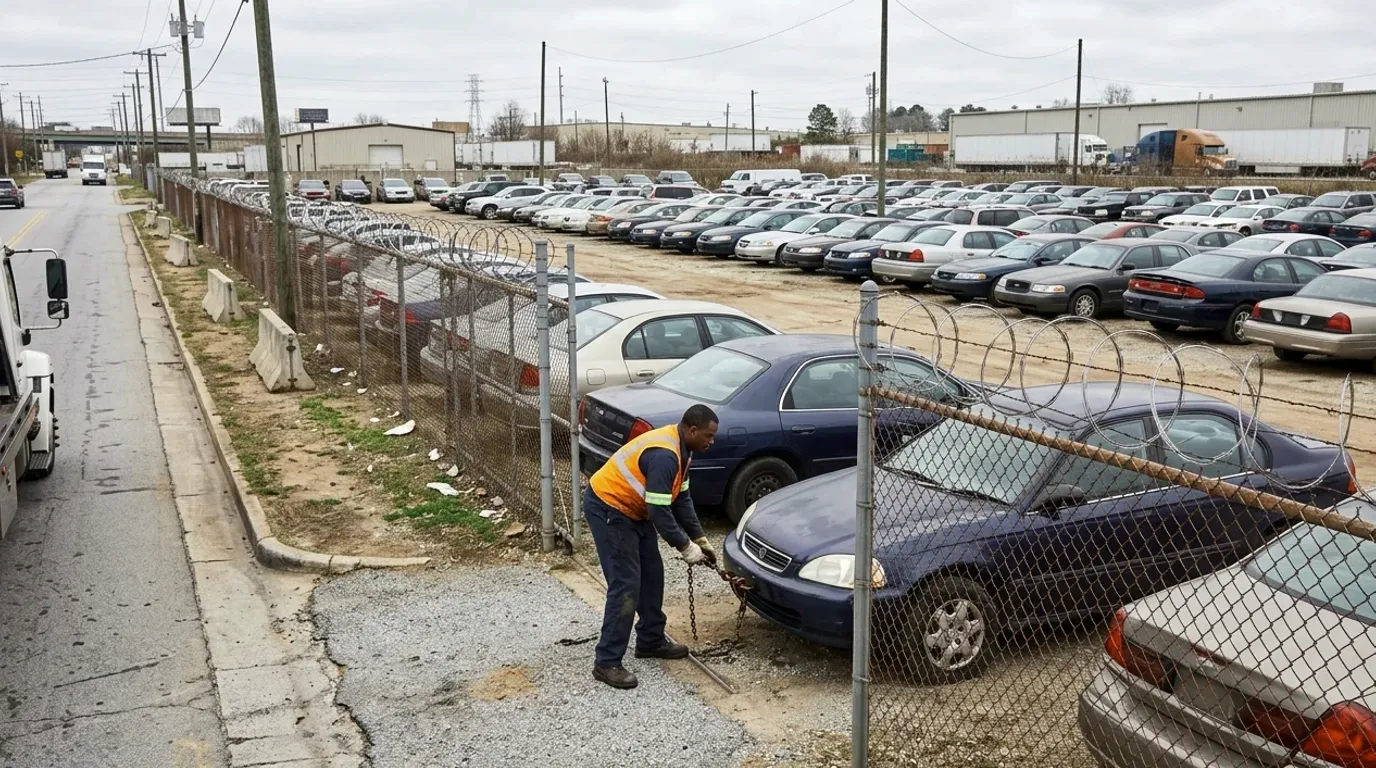
The Georgia towing statute does not say a tow company must hand over your belongings before you pay, and it does not say it can hold them hostage either. What it requires is narrower: the sign at the lot where you were towed must tell you where to recover the vehicle or your personal property. Whether the yard will release a phone charger, a work bag or a child seat before the bill is paid comes down to the yard’s own practice, so it pays to ask early and put the answer in writing.
That is an unsatisfying answer, so this page lays out exactly what the law covers, where it goes quiet, and the practical steps that usually get your things back.
What the statute actually says
For a tow from private property without the driver’s consent (an apartment lot, a shopping center, a church lot), O.C.G.A. § 44-1-13 governs. The text, as published by FindLaw, requires the posted notice to include “information as to the location where the vehicle or personal property can be recovered,” along with the cost of recovery and the form of payment.
Three things are worth noticing:
- The statute talks about recovering personal property in the notice. It does not set out a separate release rule for items inside the car.
- It does not list which payment methods a yard must accept, only that the notice must say which ones it takes.
- It does not set a complaint procedure. It gives the Department of Public Safety authority to regulate non-consensual towing and lets an injured person bring a court action.
We read that text directly. We did not find a line that lets a yard keep your belongings, and we did not find one that forces release before payment. Anyone who tells you the answer is simple in either direction is guessing.
What this does not cover
The state law is about non-consensual private-property tows. The Georgia Attorney General’s towing and booting guidance says the law does not cover consensual towing, towing from government property, or towing within a municipality that has not authorized towing by ordinance. A car taken by a police order goes through the city or county that ordered it, and a car you called a truck for is a private deal with the operator.
So the first job is naming which kind of tow you had. If an Atlanta Police officer ordered it, the release rules come from the city and the zone wrecker. If an apartment manager called it in, you are in the statute described above.
A realistic plan for getting your things
Most disputes over belongings are small and get settled at the counter. These steps keep it that way.
- Call before you drive over. Ask the yard what it will release before payment, what ID it wants, and its hours. Write down the name of whoever answers.
- Ask for the answer in a text or email. A written reply is worth more than a phone memory if you end up filing a complaint.
- Photograph the sign at the lot where you were towed. It should show the recovery location, the cost and the payment methods. A missing or incomplete sign is a defect in the tow itself.
- List what you need most. Medication, a work laptop, a child seat, paperwork. Mention these specifically, so the person at the counter knows what is urgent.
- Bring a camera. Photograph the car and its contents before you leave the lot, and take a picture of any inventory sheet you sign.
If the yard says no, ask which rule or policy it is relying on. Ask whether it is a written policy or a verbal one, and ask for it in writing.
If the yard still refuses
You have a few places to go, none of them instant.
- Georgia DPS. The Department of Public Safety regulates non-consensual towing and has a complaint form for towing companies (Form TR0031, posted on gamccd.net). Attach photos, receipts and invoices.
- The property owner. The lot’s owner or management company signed the towing contract. A call from a tenant or customer about a yard’s behavior can carry weight.
- A court action. Section 44-1-13(e) allows a person injured by a violation to sue, with actual damages presumed to be at least $100, and three times actual damages for an intentional violation. Whether your situation fits is a question for a lawyer or the clerk of your county’s magistrate court.
None of this should stop you from paying under protest if you need the car that day. Keep the receipt and write what you disputed on it.
Two habits that help
Tell the attendant up front which papers you need to prove the car is yours, since you will be asked for them at the counter. And walk around the car in the yard before you sign anything, because a damage claim gets harder once you have driven away.
The private property tow page covers how these tows start, and your rights when your car is towed in Georgia walks through the dispute side in more detail. If you are still hunting for the car, start with where is my towed car in Atlanta.
Frequently asked questions
Can a tow yard hold my belongings until I pay?
The statute we read does not give a yard that right in so many words, and it does not forbid it. Ask the yard what it will release, get the answer in writing, and file with DPS if the tow itself broke the rules.
Does the tow yard have to tell me where my property is?
For a non-consensual private-property tow, the posted notice must give the location where the vehicle or personal property can be recovered. If the sign did not, say so in any complaint.
Can I send someone else to collect my things?
Many yards want the owner’s ID and proof of ownership, or written permission. Ask what they accept before the person makes the trip, since this is a yard policy we could not confirm in a published rule.
What if my belongings are damaged or missing?
Photograph everything at the lot and file a complaint with the yard in writing first. If it goes nowhere, a court action under § 44-1-13(e) may apply to a violation of that statute. A lawyer can tell you whether your facts fit.
For a tow or roadside call in metro Atlanta, the line takes calls 24/7 at (858) 925-5546.