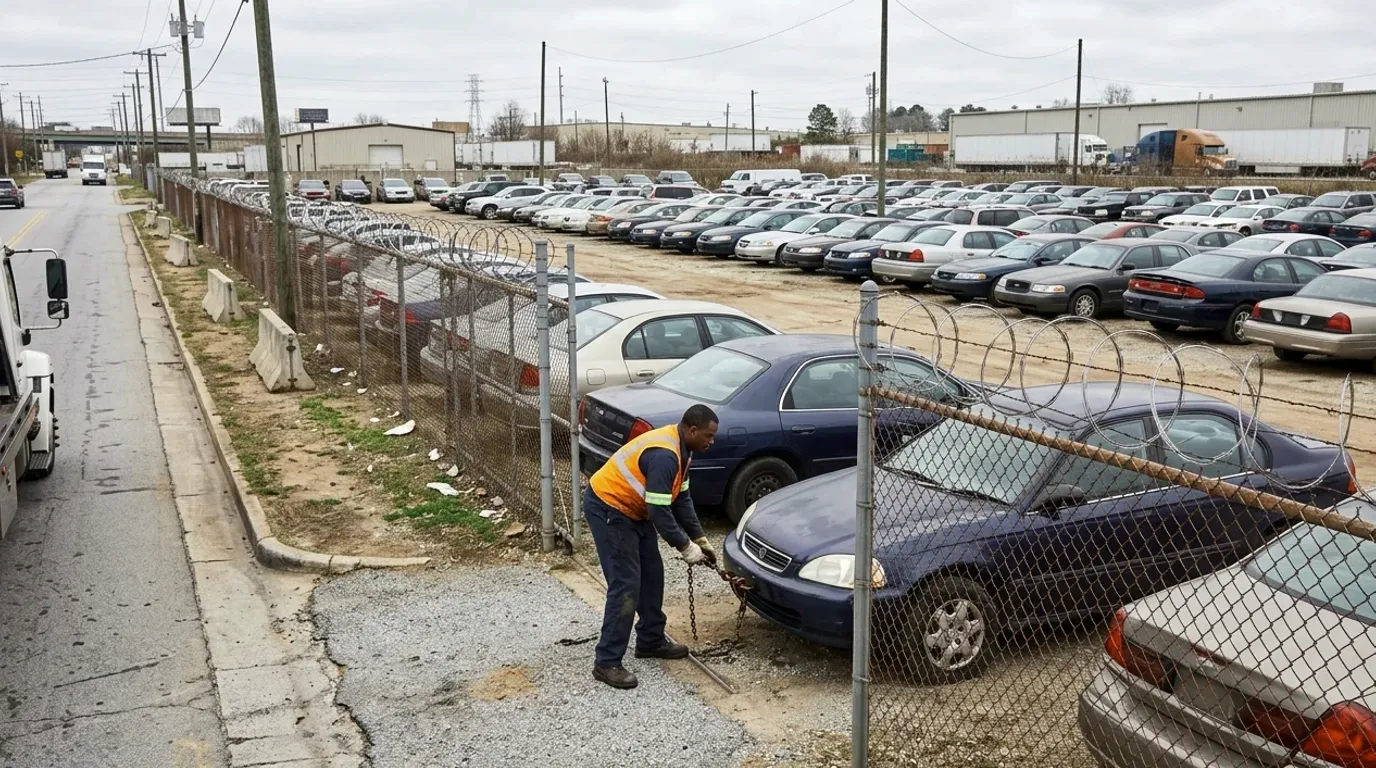
If your car was towed from a private lot in Georgia, you have a short list of rights that you can check at the yard, line by line: the posted sign, a fee ceiling, a free first 24 hours, a choice of payment, someone to release the car by phone, and an itemized receipt. Check each one before you hand over money.
This checklist applies to non-consensual tows, meaning a car removed from an apartment, retail or HOA lot without your request. It does not cover a police impound, which follows different rules. The two systems are explained in where your towed car is.
Before you go to the yard
- Photograph the sign. The law, O.C.G.A. § 44-1-13, requires a posted sign within 50 feet of each lot entrance, or visible from every space where there is no entrance. It must be at least 12 by 18 inches with lettering at least 3/4 inch, and it must name the tow company, the retrieval address, the cost of recovery and the accepted payment methods.
- Note the time. Write down when you last saw the car and when you found it gone. Storage clocks and disputes both start from times.
- Call first. Get the amount owed, the address, and who is available to release the car.
The checklist at the counter
1. The tow fee stays under the state ceiling
Georgia’s Maximum Rate Tariff No. 5, effective June 17, 2024, sets the ceilings for a vehicle of 10,000 lbs GVWR or less. The tow fee tops out at $228. The DPS tariff page has the full text. If the number on your bill is higher, ask for the legal basis.
2. No storage for the first 24 hours
Storage is capped at $33 per day, and none can be charged for the first 24 hours. The state rule also says no storage can be charged for any day the lot is closed or the car is not available to be reclaimed.
3. Extra fees have limits too
Additional fees after 72 hours can run up to $65. Total notification charges are capped at $91. Ask which line on the bill is which, and compare it with the tariff.
4. You choose how to pay
Under Georgia rule 570-38-7-.18, the operator must accept cash, commonly recognized travelers checks, money orders, certified checks or cashier’s checks, at your choice. It may also accept debit or credit cards, but it cannot charge extra for using one. The rule text is in the Georgia Rules and Regulations.
5. Someone must be reachable to release the car
The rule requires an attendant on site or available during normal business hours five days a week and at least four hours one additional day. After hours, an attendant must be reachable by phone 24 hours a day, seven days a week, and able to come to the lot in a timely manner. If the gate is locked at 9 p.m., a phone call should still get the car out.
6. You get an itemized receipt
The receipt must show the total charged and a description of each specific charge, plus the date and time of release. The payer signs it, and the attendant signs it too. Do not leave without a copy.
7. Return before it is hooked and you pay nothing
If the operator has not yet hooked or loaded your car and you come back with the key and drive off right away, the operator must not tow it away and cannot charge a fee. If it is already hooked or loaded but still on the property, the operator may charge an operator’s fee, but no storage or other fees. For more on the moment of the tow itself, see what happens if you are in the car.
Signs that the tow may not have been lawful
State law forbids a few specific practices. Watching a lot automatically or systematically for tow purposes is unlawful, because the operator is supposed to be called about each individual trespass. Paying kickbacks from a tow firm to a property owner for the right to remove vehicles is also unlawful, with a $1,000 fine for each. Operators must hold a permit, post it at the main office, carry a copy in the truck, and have a written contract with the property owner on the state form.
If any of that looks off, take photos and read the illegal private-property tow guide. A dispute usually moves faster with a paper trail than with a raised voice.
What we could not confirm
The state tariff text we reviewed contains no step-by-step procedure for pulling personal belongings out of a towed car, and no rule specific to a car with someone inside. We are not going to guess. The post on keeping your belongings covers what could be confirmed. We also did not confirm a per-mile rate for non-consensual tows, so treat any per-mile figure as unverified.
Frequently asked questions
Can the tow yard refuse a debit card?
The rule says the operator may accept cards, but it must take cash and the other listed forms of payment. Bring a cashier’s check or cash if you are unsure.
What if the yard says it is closed?
Ask for the after-hours number from the sign or the property. The rules require a phone-reachable attendant at all hours.
Do these caps apply to a police tow?
No. A City of Atlanta police tow is capped at $125 by city code, with its own free first 24 hours. See the cost breakdown.
Should I pay under protest?
If the amount looks wrong and you need the car, pay, get the itemized receipt, and keep photos. Then take it up with the operator or the state.
If you need a tow or roadside call afterward, the line at (858) 925-5546 takes calls 24/7.