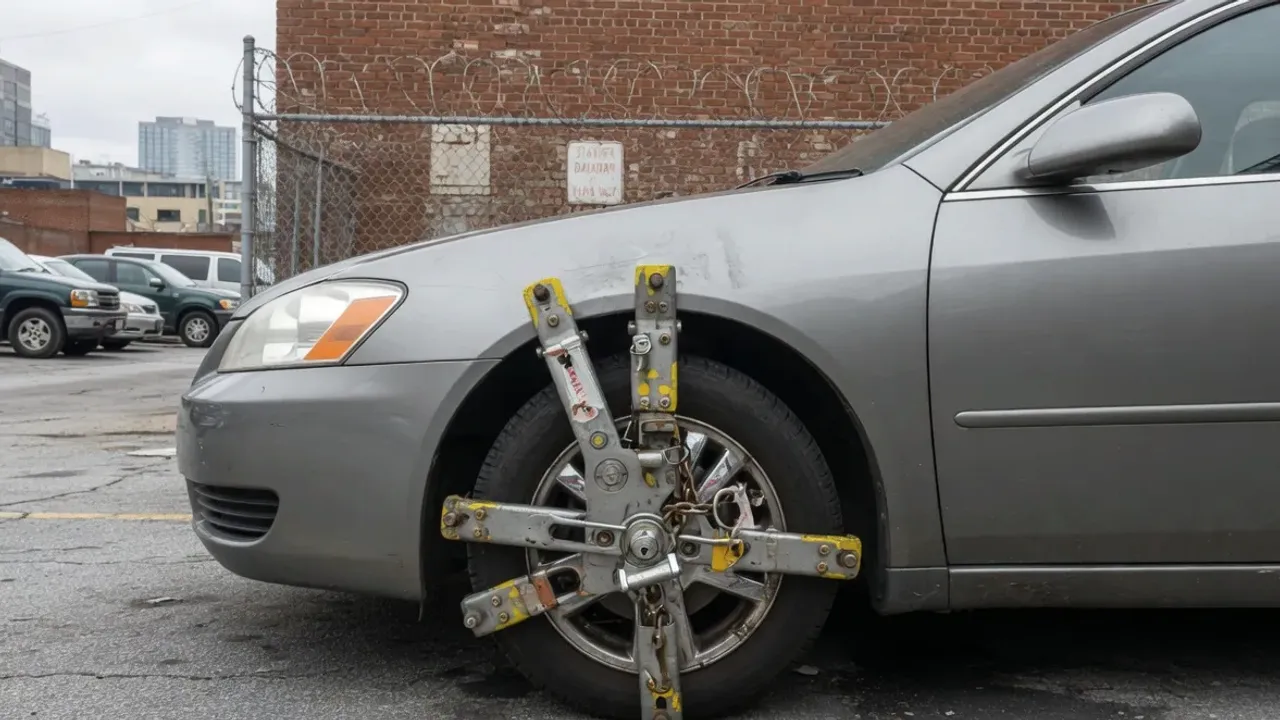
Call the agency that controls the street, not a tow company. Inside the City of Atlanta that starts with ATL311 (dial 311, or use atl311.com), and outside the city it is the police or sheriff’s non-emergency line for the county you live in. Georgia law bars standing or parking in front of a public or private driveway, so you have a legitimate complaint. Whether the car is moved quickly depends on who owns the pavement it sits on.
Calling a tow truck yourself is where people get into trouble, so the rest of this page explains why and what to do instead.
What Georgia law says about driveways
O.C.G.A. § 40-6-203 lists the places where standing or parking is prohibited. Among them, in the text published by FindLaw, is “in front of a public or private driveway.” The same list covers places like sidewalks, crosswalks, fire hydrants and intersections. There is an exception for momentarily picking up or discharging passengers, so a delivery driver idling for two minutes is a different case than a car that has been there since breakfast.
The statute we read does not set a fine or authorize a tow on its own. Those details come from the local ordinance and whichever agency enforces it, so we are not quoting a penalty here.
Step 1: work out whose street it is
Where the car sits decides who responds.
- A city street inside Atlanta. The City of Atlanta runs ATL311, which handles non-emergency requests. Our research notes dialing 311 inside the city, or visiting ATL311.
- A county road or unincorporated area. Fulton, DeKalb, Cobb, Gwinnett and Clayton each have their own police or sheriff’s office, and the call goes there. If you are in one of the smaller cities, such as Decatur, Smyrna or Marietta, the city’s own police department is the right call. We did not confirm a single phone number that works for every one of these, so look up the non-emergency number on the agency’s own website.
- A private road or an apartment lot. The street belongs to the property owner or association, so the call goes to the property manager. Under § 44-1-13 a tow from private property has to be requested by the owner or authorized agent, through an operator with the right permit and contract.
- Your own driveway on a private street in an HOA. Check whether the association or the management company handles parking complaints.
Do not use 911 unless someone is trapped, blocked in during an emergency or being threatened.
Step 2: record what you can
Before you call, take the evidence a dispatcher will ask about:
- Photos of the car in front of the driveway from two angles, with the house number or street sign in frame.
- The plate, make and color.
- The time you first noticed it and how long it has been there.
- Whether you can still get your own car out, because the dispatcher will ask.
Knocking on neighboring doors first can save everyone time. The car may belong to a visitor of a neighbor who will move it right away.
Why you should not call your own tow truck
It feels logical. It is your driveway. But the Georgia Attorney General’s towing and booting page explains the state’s non-consensual towing law, which covers private property and requires a towing company to have an agreement with the property owner and to be registered with DPS. A random truck you flag down on your own is unlikely to fit any of that, and if the car’s owner later says it was damaged, you are the person who requested the tow.
A residential property of four units or fewer is exempt from the sign requirement, per the statute text, but that exemption does not make every driver a legitimate tow customer. If you want a car removed from your private lot, ask the police first whether they will handle it, or ask a licensed operator how they would document the request. The private property tow page explains how a lawful removal starts.
If your own vehicle is trapped and you need help getting it out, that is a different job. A winch-out or roadside assistance call may be the answer when the blocking car is not going to move.
What a lawful tow looks like afterward
If the city or county sends a wrecker, the car lands in one of the places described in where is my towed car in Atlanta. The owner of the car pays to recover it, and that is the whole point of the process. If a private operator removed it from your lot, the driver will face the rate ceilings covered in are towing fees regulated in Georgia.
If the same car keeps turning up, keep a dated photo log. It gives the city or county something concrete to act on.
Frequently asked questions
Can I tow a car that is blocking my driveway in Georgia?
Not on your own. A tow from private property has to be arranged under the rules in § 44-1-13, and a street is enforced by the city or county. Call the agency first.
Is it illegal to park in front of a driveway in Georgia?
Georgia’s parking statute lists “in front of a public or private driveway” among the places where standing or parking is prohibited, with an exception for momentarily picking up or letting out passengers.
Who do I call inside the City of Atlanta?
Start with ATL311, which is the city’s non-emergency line. Dial 311 inside the city or use atl311.com.
What if the car is parked on my own property?
That is private-property towing. The owner or an authorized agent may have it removed through a permitted operator who has a written agreement with the owner. Ask the police how they want it handled.
If you need a tow or roadside help in metro Atlanta, the line takes calls 24/7 at (858) 925-5546.