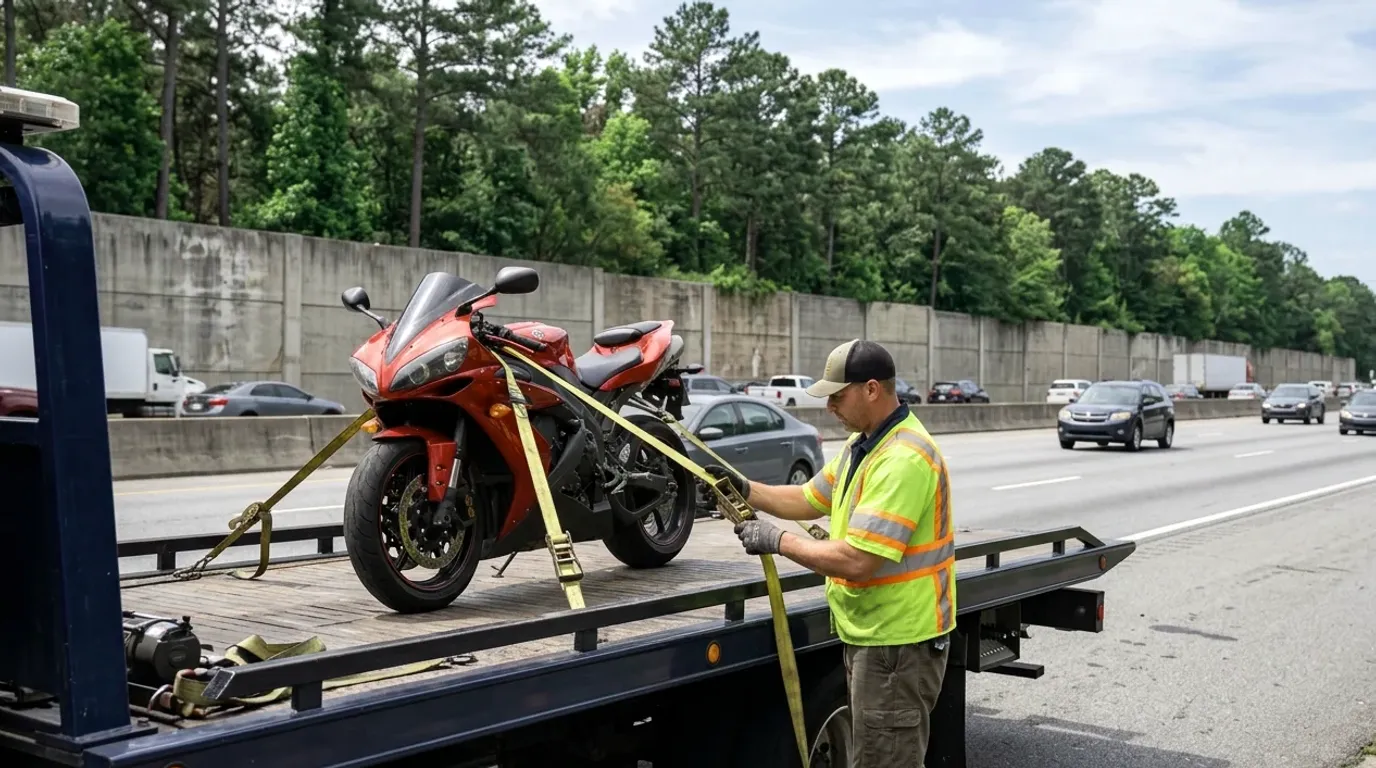
A motorcycle that will not ride needs a truck that can carry it upright, a way to hold the front wheel, and straps that do not touch anything fragile. In metro Atlanta that usually means a flatbed with a wheel chock and soft loops. The way it is loaded matters as much as the truck, and what you tell dispatch decides both.
Quick Tow ATL is a referral line. We match drivers with independent licensed operators and do not own trucks, so the operator we send does the loading. Here is what to ask for and what to watch.
Why a bike is not a small car
A car sits on four tires and stays put on a hook. A motorcycle balances. Pull one wheel off the ground and the bike has to be held in place by something other than its own stance.
On a flatbed, the whole bike rides on the deck. A chock cradles the front tire so it cannot swing, and straps pull the bike down against its own suspension. That keeps the load from rocking over bumps on I-285 or the Connector.
A wheel-lift lifts one end of the vehicle and lets the other roll behind. It works on a car. On a bike it asks the forks, the swingarm or the frame to carry weight they were not built to carry while the machine pivots. Some operators have a bike-safe method for it. Ask before you accept it, and treat it as the exception.
How the operator should load it
You do not need to supervise, but a few things are worth seeing.
- The front wheel goes in a chock. If the truck has no chock, ask what holds the front end.
- Soft loops, not hooks. A loop placed over the lower fork or a solid frame point spreads the load. A metal hook on a brake line or a hollow bar end can crush or tear.
- Straps go to solid points. Frame, triple clamp area or a swingarm mount, not plastic, not an exhaust, not a mirror stem.
- Tension, not cranking. The suspension should compress a little so the bike cannot bounce loose. If the forks are bottomed out, it is too tight.
- A second set at the rear. Two points at the back stop the tail from walking.
If you see a strap against painted plastic or a cable, say so before the deck levels. The operator would rather adjust now than hear about a scratch later.
What to tell dispatch
The call decides which truck is sent, so give it everything you can in the first minute.
- Type of bike. Sportbike, cruiser, touring bike, scooter, dual-sport or trike. A trike and a sidecar rig need a wide, level deck.
- Whether it stands. Is it upright on its stand, leaning on a wall or lying on its side?
- What is fragile. Low fairings, aftermarket pegs, carbon parts, saddlebags that hang low.
- Where it is. Shoulder, parking deck, driveway or shop. Name the road, direction and nearest exit.
- Whether it was in a crash. A bike with bent forks or a seized wheel needs a winch, not a roll-on.
- Where it is going. A shop in Decatur and a driveway in Peachtree City are different trips.
Take off anything loose before the truck arrives, such as a phone mount, a tank bag or a helmet clipped to the seat.
What moves the price
For a tow you request, no Georgia rate cap applies. The City of Atlanta’s $125 cap covers police-ordered tows, and the state tariff covers non-consensual private-lot tows. Neither prices a tow you asked for, so the operator quotes the total. We do not publish a motorcycle rate, because we could not confirm one we would stand behind.
The things that usually move a quote:
- Distance. The longer the trip, the higher the total.
- Time of day. Overnight, weekend and holiday calls cost more with many operators.
- Access. A bike in a tight alley or on a steep drive can take more labor than one on a flat shoulder.
- Condition. A rolling bike is simpler than a crashed one that has to be winched.
- Equipment. A truck with bike-specific tie-downs may price differently from a standard deck.
Ask for a single total that covers pickup, drop-off, fuel and any after-hours charge, and ask which truck is coming.
If it is on a highway
Get yourself and any passenger away from the lane and behind the guardrail, then call. The Georgia DOT HERO program patrols metro freeways and can help clear a stopped vehicle out of traffic. It is not a ride to a shop. See GDOT HERO.
For a bike in a garage or a tight driveway, parking garage towing covers how height limits change the truck.
Frequently asked questions
Can any tow truck move a motorcycle?
Not safely. Many trucks in the metro are set up for cars. Say the word motorcycle on the first call so a truck with the right gear is sent.
Is a wheel-lift ever acceptable?
Sometimes, in a space where a long deck cannot fit. The operator on scene should explain how the bike will be held. If they cannot, ask for a different truck.
Can I ride along?
Ask the operator. Some cabs have a seat for you, and some do not. Do not ride on the deck.
Do you move bikes long distance?
Out-of-town trips are quoted by the operator. See long-distance towing and the motorcycle towing service page.
If your bike is stuck, the line takes calls 24/7 at (858) 925-5546.