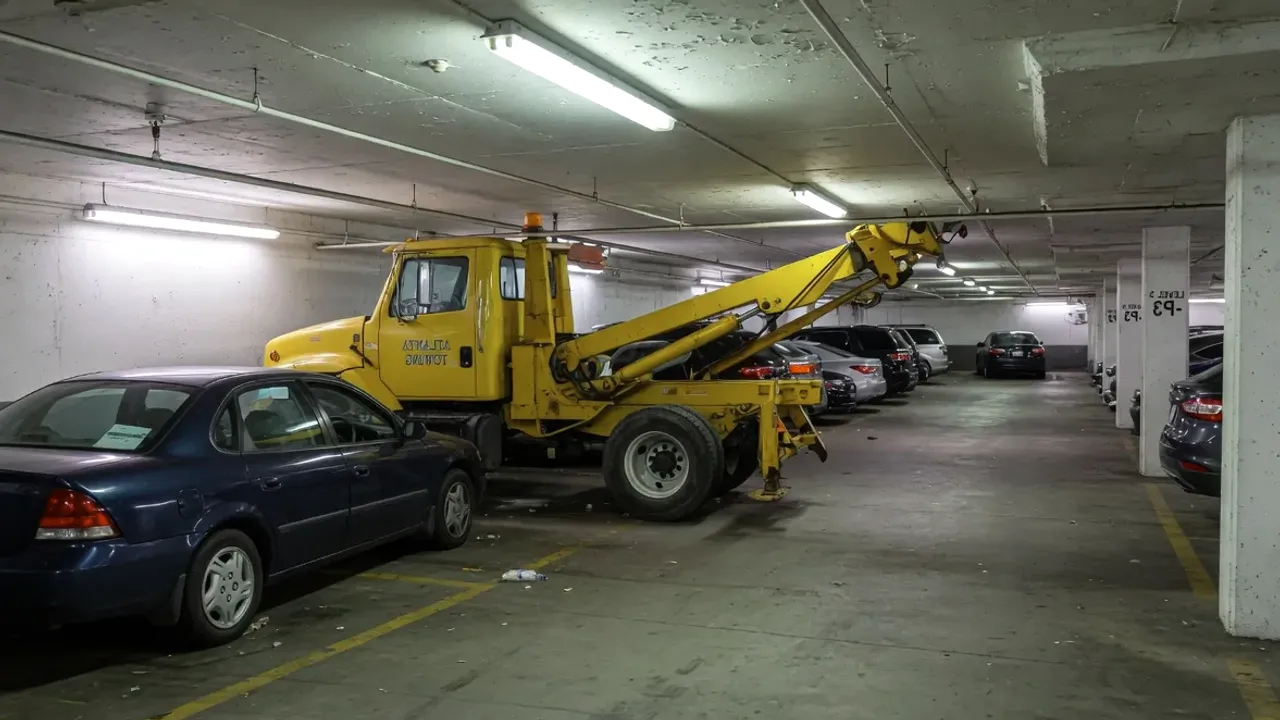
A standard flatbed is often too tall for a parking deck. Many garages post a height limit at the entrance, and a flatbed with its deck and rigging can be taller than that limit. So the truck sent to a stuck car in a deck is frequently not the one you picture.
Quick Tow ATL is a referral line. We connect you with independent licensed operators and do not own trucks, so we cannot promise any particular truck. What we can tell you is what to say on the call so the right one is sent.
Why a garage changes the truck
Three measurements decide whether a truck gets in.
- Height. The posted bar at the entrance is the limit. Beams, pipes and signs inside can sit lower than the bar.
- Turning room. Short ramps and tight spirals make it hard for a long bed to swing around.
- Weight. Older decks and some upper levels are not built for heavy trucks.
When a standard flatbed does not fit, there are a few options.
- A low-profile truck. Some operators carry a small wrecker, a wheel-lift unit or a truck with a lowered boom made for decks.
- A dolly or a skate. Small wheel dollies let an operator move a dead car by hand or with a winch to a spot where a bigger truck can reach.
- A winch pull. The operator uses a cable from outside, along a straight aisle, to bring the car to the ramp.
The details depend on the garage and the car. The operator on scene decides.
What to tell dispatch
The more precise you are, the better the first truck matches.
- Name of the garage and level. A city deck, an office tower and a mall each have different rules.
- Posted height. Read the entrance sign and say the number.
- Where the car is. In a stall, in an aisle or blocking a ramp.
- Condition. Does it start, steer or roll, and is the parking brake stuck?
- Drive type. All-wheel-drive and electric cars should go on a flatbed or dollies, and a low deck truck may not be able to do that.
- Gate or code. If a code, fee or attendant is required, say so.
Then ask which truck, and ask for one total price before it rolls.
A worked example
Say a car will not start on the third level of a downtown deck with a posted height bar. A normal flatbed cannot enter. The dispatcher asks about the car and the garage, and the operator chooses between a compact wrecker with a wheel-lift and a dolly setup.
Neither is certain to work. If the car is front-wheel drive and rolls freely, a wheel-lift often fits. If it is all-wheel drive or its parking brake is stuck, the operator may need dollies and a winch. Either way, the first call should give all of this, so a second trip is not needed.
If the car has already been towed
A deck that tows you is a different situation. Georgia’s O.C.G.A. section 44-1-13 and the state DPS Maximum Rate Tariff No. 5 cover non-consensual private-property tows of vehicles at or under 10,000 pounds. The tariff caps the tow fee at $228 and daily storage at $33, with no storage for the first 24 hours. Signs must be posted near each entrance. See Georgia’s statute and the DPS tariff page.
To find a towed car, see where is my towed car in Atlanta. If a boot is on the wheel instead, that follows different fees.
Those caps do not apply to a tow you requested from the deck. For that, the operator quotes a price, and the call is consensual.
Common deck trouble in Atlanta
Stuck cars in decks come up around the same places: stadium events, airport-area hotels, downtown offices and MARTA lots. Overnight rules are strict at MARTA stations, where vehicles can be ticketed or towed. Stadium lots close a couple of hours after events. If you must leave a car, read the sign first.
Frequently asked questions
Can any tow truck go into a parking garage?
No. Height, turning room and floor weight limits keep many trucks out. Ask for one that fits.
Does this cost more than a street tow?
It may. Specialty equipment or extra labor can raise the quote. Ask for the full price before dispatch.
What if the car will not roll?
Tell dispatch. The operator may use dollies or a winch.
What if my car is low?
See low-clearance car towing and the wheel-lift towing service page.
For help, the line takes calls 24/7 at (858) 925-5546.