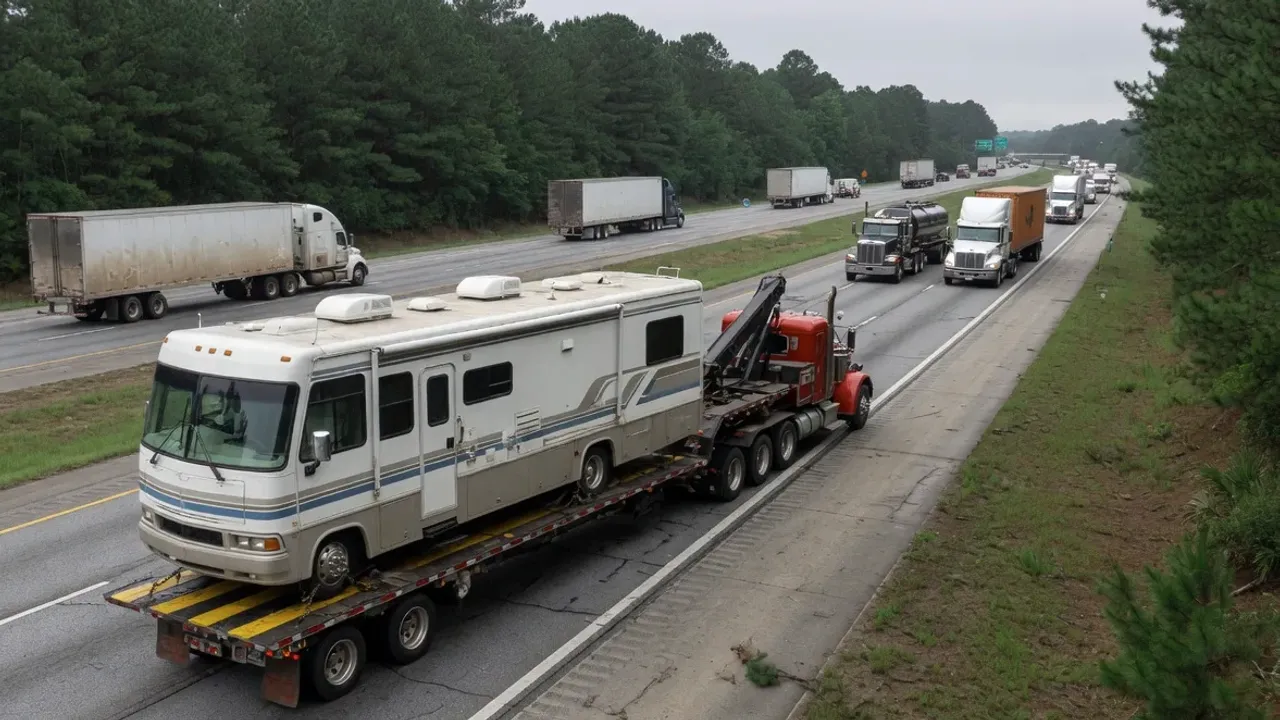
An RV or large trailer needs a truck sized to the rig, and the quickest way to get one is to tell dispatch what you have before they pick a truck. Class, length, whether it rolls and steers, and where the slide-outs are all change the equipment.
A car wrecker that handles a sedan all day cannot assume it can lift a 35-foot coach. Send the wrong truck and you pay for a trip that ends with a second call.
What to tell dispatch
Keep this list on your phone or a sticky note in the glove box. Dispatch will ask for most of it anyway.
- What it is. Class A, B or C motorhome, travel trailer, fifth wheel, toy hauler, or a bumper-pull trailer.
- Length and height, as best you know. The length on the registration or the sales sheet is fine. Height matters for decks, tunnels and low bridges at the drop-off.
- Whether it runs. Does the engine start, does it steer, and do the brakes release? A coach that will not roll is a winching job.
- Slide-outs, awnings and steps. Pull in anything that will retract. Tell them what will not.
- Anything hooked up behind it. A towed car, a bike rack, or a second trailer. Each adds weight and length.
- Where it is. Mile marker and direction on the interstate, or the campground, storage lot or dealer address.
- Where it is going. A repair shop in Marietta, a storage yard in McDonough, or home in another state are three different trips.
The more of this you give up front, the less likely it is that a second truck has to be sent.
Which roads cause most of these calls
RV breakdowns in the metro cluster along the long freight and vacation routes:
- I-75 south through Forest Park, Morrow, Stockbridge and McDonough, the main road to Florida.
- I-75 north through Marietta and Kennesaw toward the mountains, and I-575 toward Woodstock and Canton.
- I-85 and the Downtown Connector, where a stopped rig blocks lanes that carry over 400,000 vehicles a day at the busiest stretch.
- I-285, the 64-mile Perimeter, where trucks and RVs share short weave zones.
- I-20 east and west for trips toward Birmingham or Augusta.
The Georgia DOT HERO program can help clear a stranded vehicle out of a freeway lane. See GDOT HERO. It is about getting traffic moving. It is not a tow to a shop.
Safety first when the rig stops
Pull as far right as you safely can, set the hazards, and get everyone out on the side away from traffic. Do not stand between the RV and the lane. If you carry triangles or cones, put them out only when it is safe to walk behind the rig. On a crowded interstate, staying put behind a barrier often beats trying to set them. Then call.
Why this is not a car tow
Several things make an RV different:
- Weight and length. Many motorhomes weigh well over 10,000 lbs. The Georgia DPS tariff figures we cite elsewhere, such as the $228 tow ceiling, are for vehicles of 10,000 lbs GVWR or less and for non-consensual private-lot tows. We did not confirm any figure for heavier rigs, so we do not quote one.
- The load itself. Slides, propane tanks and a hitch need handling that a car does not.
- The drop-off. A storage lot or a shop must be able to take a rig that size. Call ahead.
For ordinary cars, see the flatbed towing page. For tractor-trailers and box trucks, heavy-duty towing is the service to ask about. The RV towing service page covers rigs like yours.
What a consensual RV tow costs
When you call for a tow, you are asking for it, and no state rate cap prices that job. The City of Atlanta $125 cap applies only to police-ordered tows and the state tariff only to non-consensual private-lot tows. Neither sets an RV tow price you requested.
So the price is whatever the operator quotes. Ask for a single total for this rig, this pickup and this drop. Ask which truck is coming, and whether after-hours work, fuel and a second operator are inside that number. Quick Tow ATL does not publish a rate for RVs.
Frequently asked questions
Can a regular tow truck haul my RV?
Sometimes, depending on size and condition, but it often needs a heavier wrecker or a rotator. That is why dispatch needs your class and length.
Should I leave the RV hooked to the tow vehicle?
Tell dispatch what is attached. A towed vehicle or trailer may need to be disconnected, or may need its own truck.
Does GDOT HERO tow an RV to a shop?
No. HERO helps clear the lane. A tow to a repair shop is a separate call you arrange.
Can I stay in the RV during the tow?
Do not plan on it. Ask the operator, and keep everyone out of the vehicle on an interstate shoulder.
If you need a rig moved, call the line at (858) 925-5546, which takes calls 24/7.