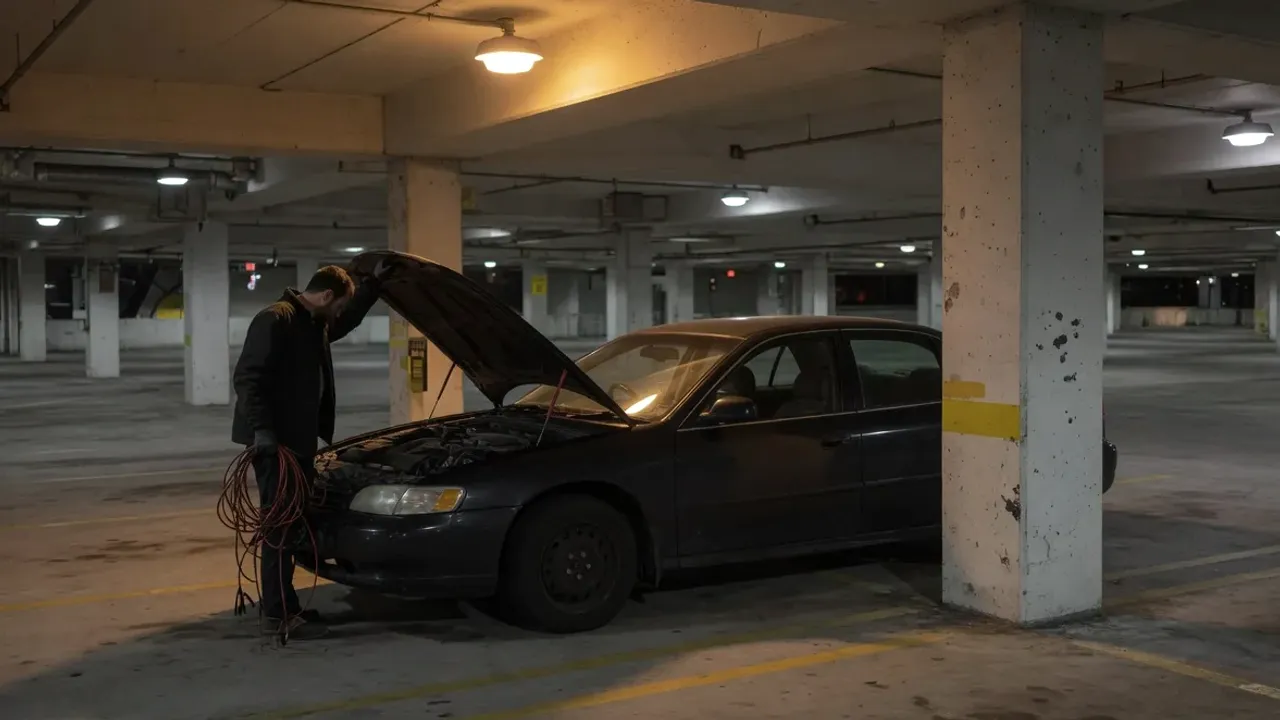
Listen to what the car does when you turn the key. The sound is the fastest clue. Most no-start problems in a parking lot are one of three things: a weak battery, a failing starter, or a car that has nothing to burn. A minute of triage tells you whether to call for a jump, a tire shop or a tow.
Stay calm and stay visible. If you’re in a deck, put the hazards on and keep to the side of the lane.
Read the sound
Rapid clicking, dim dash lights. This is the classic weak battery. The car tries to crank and doesn’t have the power. A jump start usually fixes it for the moment.
One loud click, then silence. The battery may be fine and the starter or its connection is the problem. Lights and radio work, but the engine doesn’t turn over. A jump won’t help much here.
Nothing at all, no lights. A fully dead battery, or a loose or corroded battery cable. Look at the terminals for white or green crust.
The engine cranks normally but won’t catch. The battery and starter are working. The engine isn’t getting fuel or spark. Check the gauge. If the tank is empty, that is a fuel delivery call, and our guide to running out of gas in Atlanta covers it.
Key turns but dash shows a key or lock symbol. An anti-theft system may not recognize the key. Try the spare key and read your manual.
Quick checks before you call
- Is the car in Park or Neutral? Many cars won’t start in Drive.
- Is the steering wheel locked? Wiggle it while turning the key.
- Is the key fob battery weak? Hold the fob against the start button if your manual shows that.
- Did you leave the lights on? Interior lights and phone chargers drain a battery in a day or two.
- Did a warm summer follow a cold snap? Atlanta heat is hard on batteries, and failure often shows up after years of slow wear.
If a jump works
A boosted car should run, but a battery that died once will often die again. Drive straight to a shop or parts store and ask for a battery test. A jump doesn’t fix a failing alternator. If the car dies again within an hour, the charging system is likely the cause and you’ll want a tow. Don’t turn the engine off until you get there.
For a jump from a friend with cables, read your manual first. Modern cars have specific connection points, and mistakes can damage electronics. EVs and hybrids have a separate 12-volt battery with its own procedure.
If a jump does not work
Stop trying. Repeated cranking can heat the starter. At that point the car needs a flatbed, or a wheel-lift if it’s a simple front-wheel-drive car. See flatbed towing if the car is all-wheel drive, an EV or in a tight deck spot.
Then pick a destination. Our guide on towing to a dealership or repair shop walks through the choice.
Parking lot specifics
Shopping center and apartment lots have limits on how long a car can sit. Georgia’s private-property rules require posted signs before a lot can have a car removed, but a car with a visible problem and an owner nearby is a different matter from an abandoned one. Tell security or the property manager that help is on the way. A text or a note on the dash helps.
Cost
A jump or lockout-style call is a consensual job, so no state rate cap applies. The operator quotes for your location and your car. Ask for one total and what could change it. Our roadside assistance without a membership guide explains the pay-per-call approach.
Calling Quick Tow ATL
Quick Tow ATL is a referral line that connects you with an independent licensed operator. The line takes calls 24/7 at (858) 925-5546. Tell the person what sound the car made, since that helps the operator decide what to bring.
Frequently asked questions
Why does my car click but not start?
Rapid clicking usually points to a low battery. A single heavy click can mean the starter.
Can a jump damage my car?
A correct jump rarely does. Wrong connections can harm electronics, which is why newer cars list specific points in the manual.
How do I know if it’s the battery or the alternator?
If a jump starts the car but it dies soon after, the alternator is a likely cause. A shop can test both.